How vitamin E shields your skin at the cellular level
Your skin is under constant bombardment. Ultraviolet radiation, pollution, even the oxygen you breathe generates free radicals — unstable molecules missing an electron that rip through cell membranes looking for one to steal. Vitamin E stops that chain reaction before it spreads.
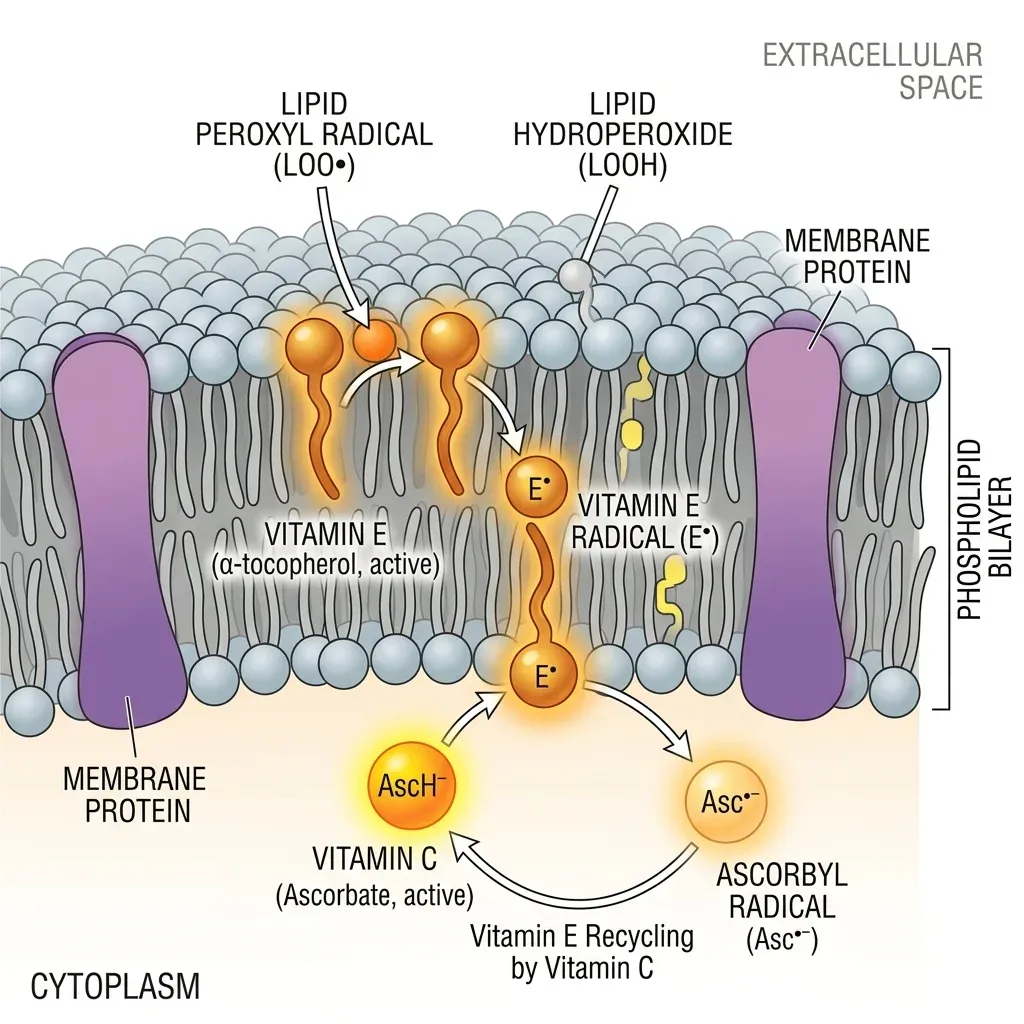
The mechanism works like a firebreak in a forest. When a free radical attacks a fat molecule in your cell membrane, it creates a new radical, which attacks the next fat, and so on. α-Tocopherol — the most active form of vitamin E — intercepts peroxyl radicals and donates a hydrogen atom, neutralizing them before they can propagate further. That chain-breaking function is why dermatologists call it a "chain-breaking antioxidant" rather than just another antioxidant.
But vitamin E doesn't work alone. Once it neutralizes a free radical, it becomes oxidized and temporarily inactive. Vitamin C steps in as the recycling partner, regenerating oxidized α-tocopherol back to its active antioxidant form. Think of it as a tag-team system where vitamin C reloads the gun after vitamin E fires it.
This partnership has practical consequences. A study published in the Journal of Investigative Dermatology found that combining ferulic acid with vitamins C and E doubled the photoprotection of skin from fourfold to eightfold against solar-simulated irradiation. That research, led by Dr. Sheldon Pinnell's group, is one reason so many high-end serums now contain all three ingredients together.
Beyond UV defense, vitamin E's γ-tocopherol form inhibits the production of PGE2 (a pro-inflammatory compound) and nitric oxide, and prevents sunburn cell formation and UVB-induced lipid peroxidation. In plainer terms: it reduces the inflammation that makes sunburned skin red and painful, and it slows the breakdown of fats that keep your skin barrier intact.
The NIH notes that vitamin E is also involved in immune function, cell signaling, and regulation of gene expression — processes that matter for skin repair after damage. At optimal doses, it enhances T-cell function and natural killer cell activity, according to a 2025 review in Cureus. So the benefit extends beyond simple UV shielding into how well your skin recovers from daily wear.
Vitamin E protects your skin membranes from oxidative damage, works best alongside vitamin C, and supports the immune cells that repair skin after UV exposure. No single nutrient handles everything. But vitamin E covers a specific, measurable piece of the defense.
Tocotrienols vs tocopherols: which form does your skin actually use?
When supplement labels say "vitamin E," they almost always mean α-tocopherol. But the vitamin E family has eight members, and the ones generating the most research interest aren't the ones you'll find in most bottles.
Vitamin E exists in eight chemical forms: α-, β-, γ-, and δ-tocopherol, plus α-, β-, γ-, and δ-tocotrienol. The structural difference matters. Tocopherols have a saturated side chain — picture a straight tail. Tocotrienols have an unsaturated side chain with three double bonds, creating a kinked tail that lets them slip into cell membranes more easily.
| Property | Tocopherols | Tocotrienols |
|---|---|---|
| Side chain | Saturated (straight) | Unsaturated, 3 double bonds (kinked) |
| Cell membrane penetration | Standard | More effective |
| Body retention | α-tocopherol preferentially retained by liver | Rapidly metabolized and excreted |
| Rich food sources | Sunflower oil, almonds, hazelnuts | Palm oil, rice bran, annatto bean |
| Most studied form | α-tocopherol (basis of RDA) | γ-tocotrienol (skin aging research) |
| Meets official vitamin E requirements? | Yes (α-tocopherol only) | No |
The complication: only α-tocopherol is recognized by the body as meeting human vitamin E requirements. Your liver has an α-tocopherol transfer protein that specifically grabs this form and packages it into lipoproteins for delivery throughout your body. The other seven forms get actively metabolized and excreted — your body treats them more like waste than nutrients.
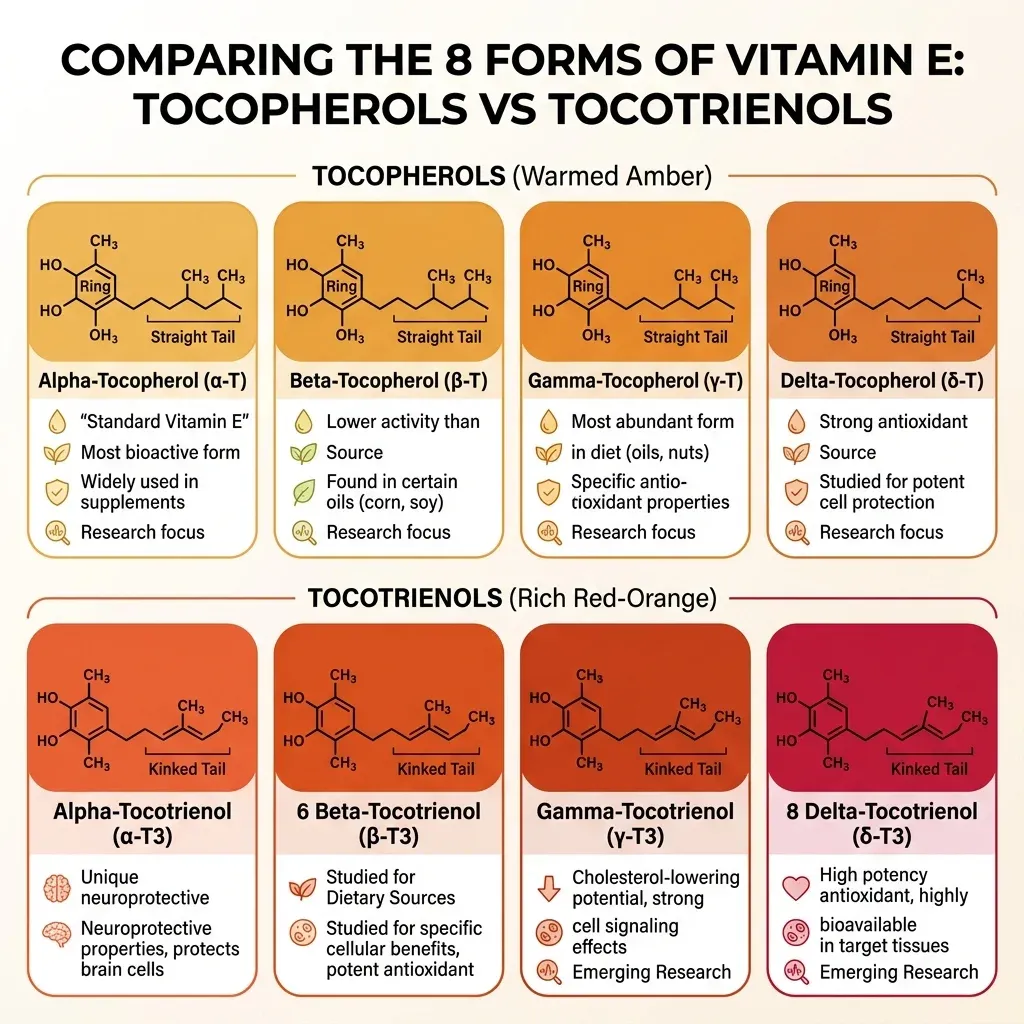
Yet tocotrienols keep showing up in skin research with results that α-tocopherol can't match. A 2022 systematic review published in Frontiers in Pharmacology found that γ-tocotrienol upregulated collagen production — specifically types I and III — and reduced inflammation markers including TNF-α, COX-2, and interleukins in aging fibroblasts. The same review noted that tocotrienols are assimilated into cellular membranes more easily and absorbed by skin more effectively than tocopherols.
Tocotrienols and γ-tocopherol are actually thought to be better scavengers of peroxyl radicals and reactive nitrogen species, respectively, than α-tocopherol in laboratory tests. And δ-tocotrienol showed greater anti-proliferative effects than tocopherols in malignant cell lines — a finding that's preliminary but intriguing.
The disconnect between the science and the supplement aisle is real. γ-Tocopherol is the most common form of vitamin E in the American diet — you get it every time you cook with soybean, canola, or corn oil — yet most supplements contain only α-tocopherol because that's the form the RDA is based on. If you want tocotrienols specifically, you'd need to seek out palm oil, rice bran oil, or annatto-derived supplements.
For your skin, the evidence suggests tocotrienols may be the more interesting form — but the research is still catching up to the marketing. Most clinical dermatology studies have been done with α-tocopherol, so that's where the strongest evidence base sits.
The best food sources of vitamin E (and why supplements fall short)
Most Americans aren't getting enough vitamin E from food. The average US adult intake from food is 7.2 mg per day — less than half the RDA of 15 mg. That gap drives millions of people toward supplements. But the way you get your vitamin E changes how much your body actually uses.
| Food | Serving size | Vitamin E (mg) | % Daily Value |
|---|---|---|---|
| Wheat germ oil | 1 tablespoon | 20.3 | 135% |
| Sunflower seeds, dry roasted | 1 ounce | 7.4 | 49% |
| Almonds, dry roasted | 1 ounce | 6.8 | 45% |
| Sunflower oil | 1 tablespoon | 5.6 | 37% |
| Safflower oil | 1 tablespoon | 4.6 | 31% |
| Hazelnuts, dry roasted | 1 ounce | 4.3 | 29% |
| Peanut butter | 2 tablespoons | 2.9 | 19% |
| Spinach, boiled | 1/2 cup | 1.9 | 13% |
Source: NIH Office of Dietary Supplements
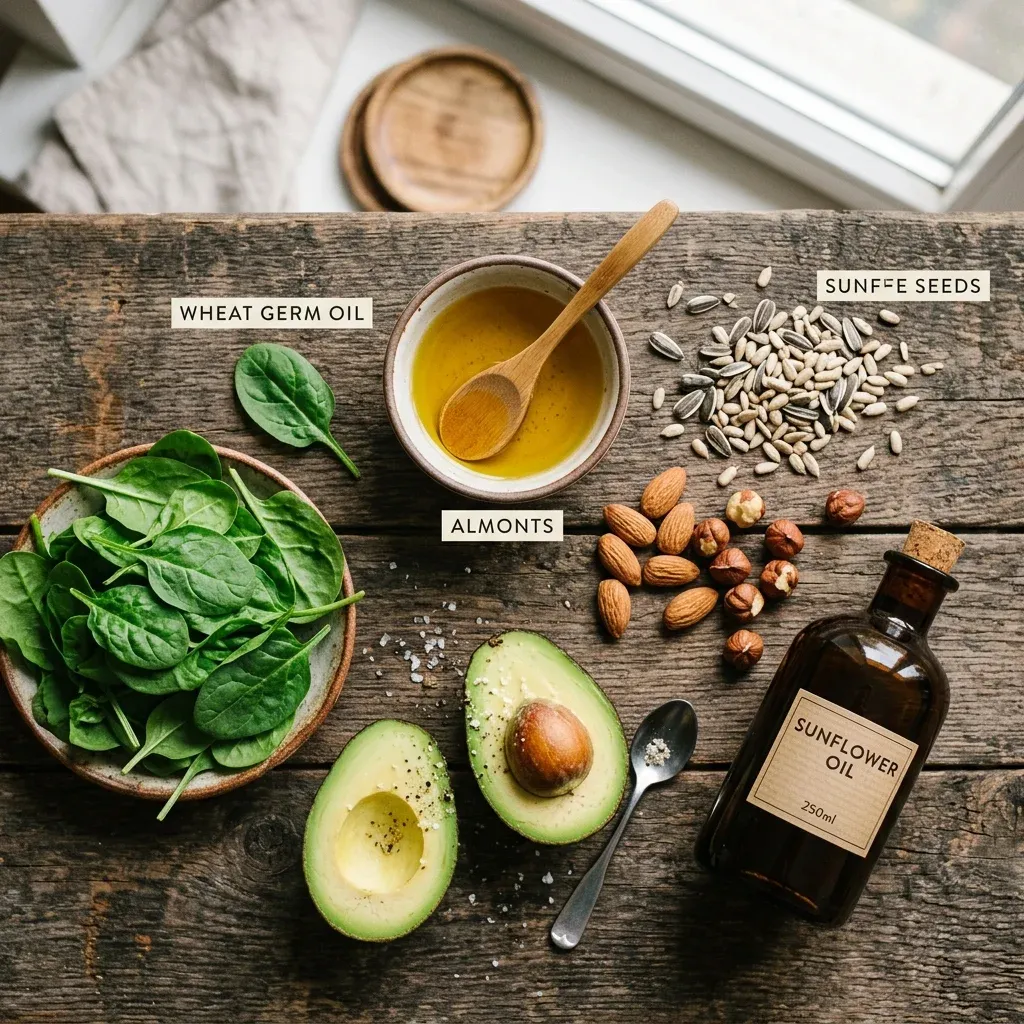
A single tablespoon of wheat germ oil delivers more vitamin E than your entire day requires. A handful of sunflower seeds or almonds gets you nearly halfway there. The pattern is obvious: vitamin E concentrates in oils, nuts, and seeds, which is both the opportunity and the catch. As people eat lower-fat diets, they often cut the very foods that deliver this nutrient.
The absorption story is where things get interesting. Researchers at the Linus Pauling Institute at Oregon State University ran a controlled study comparing different ways of taking vitamin E. A 400 IU vitamin E pill taken with just a glass of skim milk raised blood vitamin E levels by only 3 percent. The same amount of vitamin E embedded in fortified cereal? Blood levels rose 30 times higher.
The lead researcher, Maret Traber — one of the foremost vitamin E experts and a member of the federal panel that set the RDA — was blunt about the implications: "People who are taking vitamin E supplements only with liquids on an empty stomach are accomplishing nothing and getting few if any benefits from the supplements."
The reason is basic biochemistry. Vitamin E is fat-soluble, meaning it dissolves in fat, not water. Without dietary fat present during digestion, the intestinal lining can't absorb it efficiently. Swallowing a capsule with your morning coffee doesn't cut it. Taking it with a meal that includes some fat — even a few nuts or a drizzle of olive oil — makes a meaningful difference.
There's another wrinkle that matters if you're buying supplements: natural vitamin E (d-α-tocopherol) is twice as bioavailable as synthetic (dl-α-tocopherol). Synthetic vitamin E contains eight stereoisomers, but your body can only use the four with the "2R" configuration. Check the label: "d-alpha" means natural, "dl-alpha" means synthetic. You get what you pay for.
Food wins on absorption consistency. It delivers vitamin E in a matrix your body evolved to process. Supplements can fill a genuine gap, but only if you take them with food and choose the natural form over synthetic.
Breaking open capsules on TikTok: what the trend gets right and wrong
Scroll through TikTok's skincare content and you'll find thousands of videos showing the same ritual: someone punctures a vitamin E gel capsule — the kind sold at pharmacies for oral consumption — squeezes the oil onto their face, mixes it with moisturizer, and reports "glass skin" by morning. The hashtag has hundreds of millions of views. Spate, which tracks beauty trends across 20 billion search signals and 60 million TikTok videos, has documented the rising consumer interest in vitamin-based skin care routines.
The trend is working from a real premise. Vitamin E is a legitimate skincare ingredient with decades of research behind it. Most over-the-counter antiaging creams already contain 0.5% to 1% vitamin E. The idea that vitamin E benefits skin isn't wrong — it's the method that dermatologists take issue with.
Dermatologist Dr. Munir Somji, who posts as @drsomjiskin on TikTok, reviewed the trend and gave it a direct verdict: oral vitamin E capsules applied to skin have "zero benefits" because they weren't designed for topical use. His reasoning comes down to formulation. The vitamin E inside oral capsules is formulated for digestive absorption — the molecule size and the carrier oils are optimized for your gut, not your skin.
Cosmeceutical vitamin E creams use molecule sizes small enough to penetrate the skin barrier. Oral capsule contents sit on the surface.
Dr. Somji's recommendation: "You can get a nice vitamin E cream that says cosmeceutical so the molecule size is small enough to make a difference to your skin barrier". These products aren't expensive. They're just not as photogenic as puncturing a golden capsule on camera.
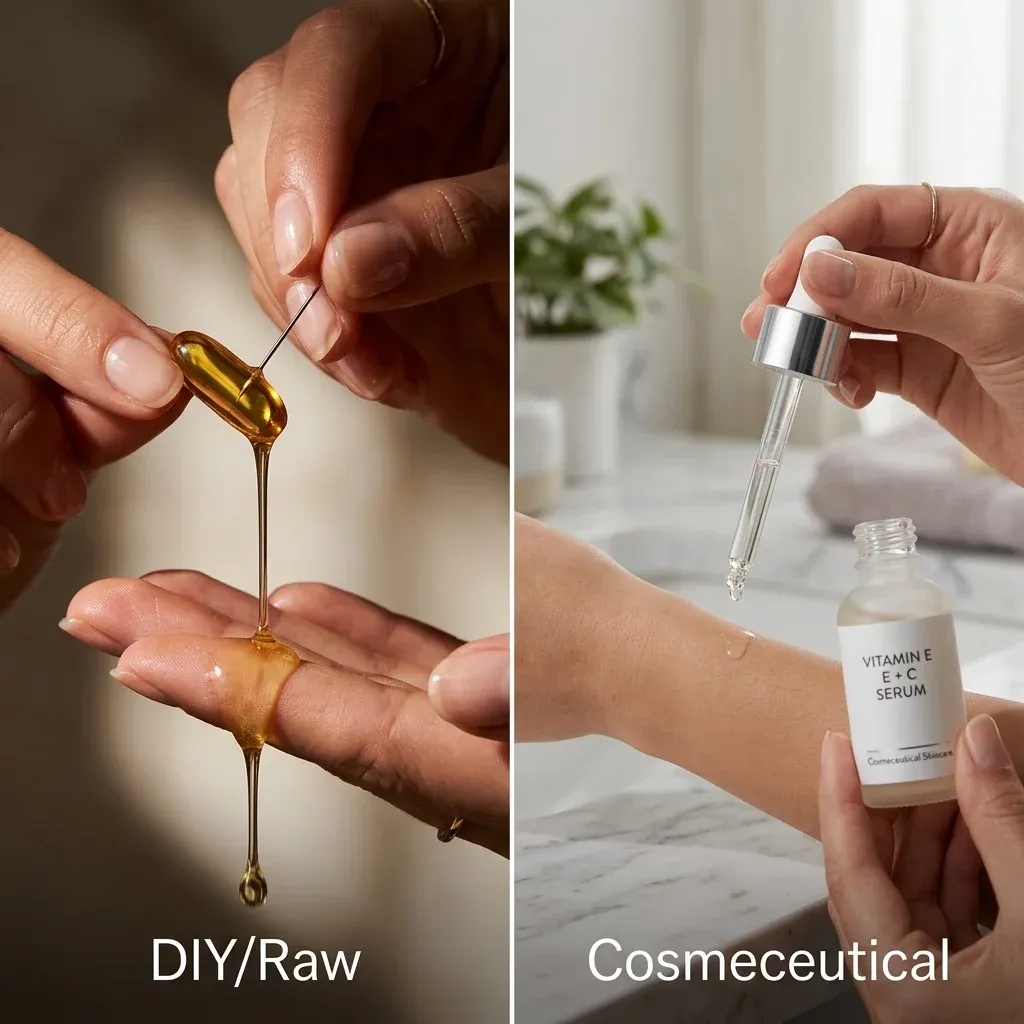
There is a stability issue too. Vitamin E occurring naturally as α-tocopherol oxidizes slowly when exposed to air, and the stability of topical vitamin E is compromised as soon as a product is opened and exposed to air and light. Puncturing a capsule and mixing it with moisturizer exposes the oil to both, potentially degrading it before it even contacts your skin.
So what does the trend get right? The instinct. Vitamin E is genuinely useful for skin when delivered properly. The problem is the execution: wrong formulation, wrong molecule size, and degradation from air exposure. If you're spending money on vitamin E capsules to smear on your face, that money would work harder in a properly formulated serum.
What dermatologists wish you knew before supplementing
Vitamin E has a reputation as a harmless vitamin you can take freely. The clinical data says otherwise, and the gap between what people believe and what research shows is wide enough to matter.
The recommended dietary allowance is 15 mg of α-tocopherol per day for adults. The tolerable upper intake level — the highest daily dose unlikely to cause harm — is 1,000 mg. Most standalone vitamin E supplements contain 67 mg (100 IU) or more, which is already over four times the RDA.
That matters because the risks scale with dose. A 2005 meta-analysis published in the Annals of Internal Medicine, analyzing 19 clinical trials with 135,967 participants, found that doses of 400 IU per day or higher were associated with increased all-cause mortality. The risk increase wasn't dramatic — roughly 39 additional deaths per 10,000 persons — but it was statistically significant and started appearing at doses as low as 150 IU.
| Risk | What the evidence shows | Source |
|---|---|---|
| All-cause mortality | Increased at doses ≥400 IU/day in meta-analysis of 135,967 participants | Kaye et al., 2025 |
| Prostate cancer | 17% increased incidence in SELECT trial vitamin E arm | Kaye et al., 2025 |
| Hemorrhagic stroke | 22% increased risk in one study; inconclusive in later meta-analyses | Kaye et al., 2025 |
| Bleeding risk with anticoagulants | Dose-dependent increase in bleeding when combined with warfarin | Kaye et al., 2025 |
| Fat-soluble vitamin absorption | High doses (>1,000 mg/day) impair absorption of vitamins A, D, K | Kaye et al., 2025 |
The Selenium and Vitamin E Cancer Prevention Trial (SELECT) found a 17% increase in prostate cancer incidence among men taking vitamin E compared to placebo. That finding was unexpected and concerning enough to stop the trial early. It also illustrates a pattern with antioxidant supplements: what protects in food-level doses can cause problems at supplement-level doses.

Bleeding risk is the most immediate clinical concern. Vitamin E inhibits protein kinase C, reduces platelet cyclooxygenase activity, and interferes with vitamin K-dependent clotting factors. If you're taking warfarin, aspirin, or other blood thinners, adding vitamin E supplements compounds the anticoagulant effect. The Cleveland Clinic advises stopping vitamin E before surgical or dental procedures for this reason.
One important nuance: no adverse effects have been found from consuming vitamin E in food. The risks emerge from supplemental doses that far exceed what food can deliver. A handful of almonds gives you about 7 mg. You'd need to eat an impractical quantity to approach supplement-level doses.
The consensus among dermatologists and the NIH is clear: if you eat a varied diet including nuts, seeds, and vegetable oils, you likely don't need a vitamin E supplement. If your doctor identifies a deficiency or specific medical need, supplementation should be at the lowest effective dose, taken with food, and monitored — especially if you take blood-thinning medication.
Vitamin E gummies: candy or credible supplement?
Thirteen percent of American adults choose their vitamins and supplements based on what appeals to them in the store. Vitamin E gummies, with their bright colors and candy-like taste, are designed to appeal. But the question isn't whether they taste better than capsules — it's whether they deliver the same thing.
On absorption, gummies hold up: bioavailability of nutrients in gummies is generally comparable to pills, according to Monique Williams, CNP, at University Hospitals. UCLA Health confirms that research shows your body can absorb nutrients in gummy vitamins as easily as those found in traditional vitamins. On the absorption front, gummies aren't inherently inferior.
The problems are in what else comes with them.
Most gummy vitamins contain between 2 and 8 grams of sugar per serving. If you're taking multiple gummy supplements daily — a common pattern among health-conscious consumers — the sugar adds up against the American Heart Association's recommended limits of 25 grams for women and 36 grams for men per day. Sugar-free versions substitute sugar alcohols that can cause bloating and digestive discomfort.
Key concern: Gummies degrade faster than pills, contain added sugar, and their candy-like taste makes overdosing temptingly easy — a real risk with fat-soluble vitamin E, which accumulates in the body.
Stability is a bigger concern than most people realize. Gummy vitamins have a limited shelf life compared to traditional supplements, and they lose potency over time. To compensate, manufacturers often overpack gummy supplements with more vitamins than listed on the label. A fresh bottle might deliver more than you need; an older bottle might deliver less than it claims.
The dosage consistency issue adds another layer. The gel-like matrix can lead to the amount of active ingredients varying slightly from one gummy to the next, according to Williams. With a precisely dosed tablet, you know what you're getting. With gummies, there's inherent variability.
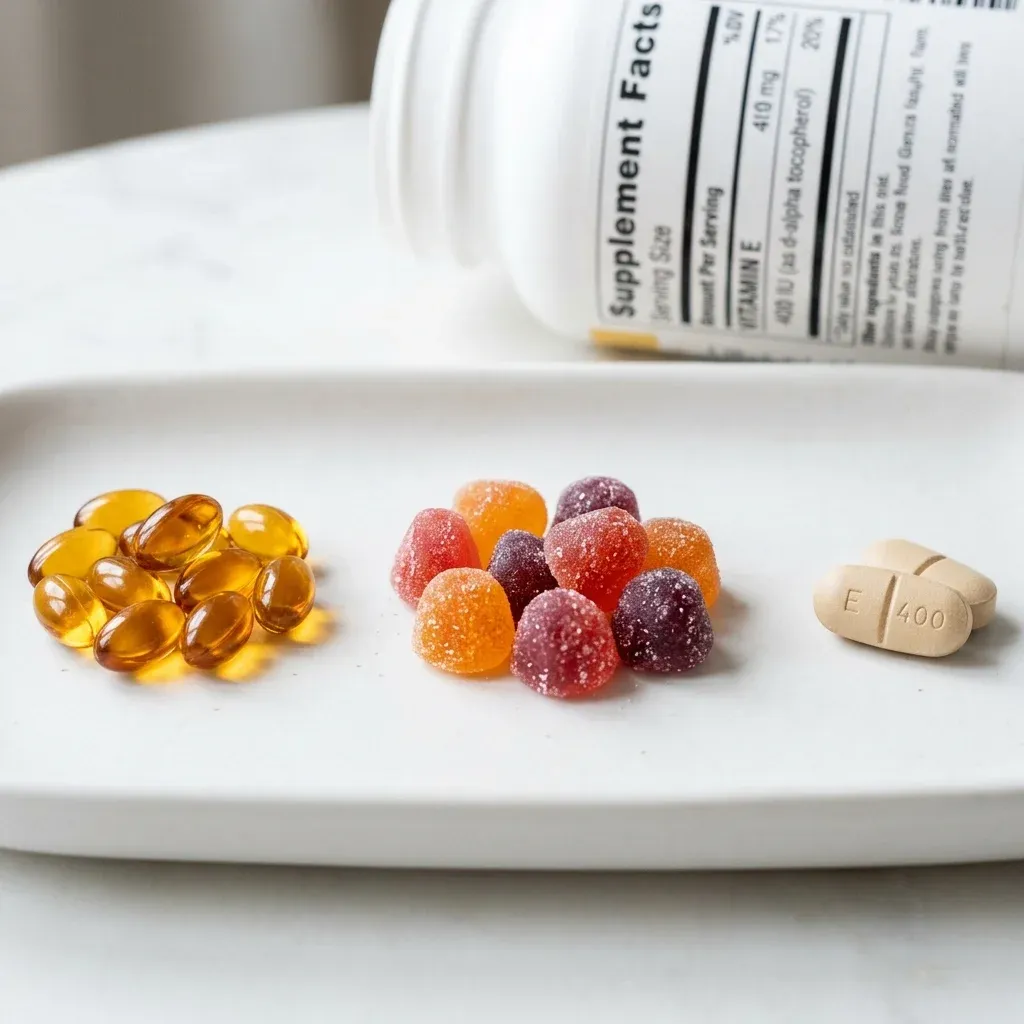
If you do choose gummies, a few things matter. Check whether the vitamin E is natural (d-α-tocopherol) or synthetic (dl-α-tocopherol) — the natural form is twice as bioavailable. Look for third-party testing seals from ConsumerLab.com, NSF International, or USP, since the FDA does not regulate supplements for accuracy. Store them in a cool, dry place — heat and humidity degrade gummy vitamins more quickly than coated pills.
Gummies aren't a bad delivery method if they're your only path to taking a supplement consistently. Williams from University Hospitals puts it well: "If a pleasant-tasting gummy is what it takes for someone to consistently take them, that's a major win for their health." But they're a compromise — trading precision for palatability. For vitamin E specifically, you'd get more reliable dosing and better value from a simple gel capsule taken with a meal.
Frequently Asked Questions
Can I use vitamin E oil directly on my skin for scars?
The evidence is mixed. Studies looking at the efficacy of vitamin E in the treatment of burns and scars have been disappointing, according to a comprehensive dermatology review. Some people experience subjective improvements in skin texture, but controlled trials haven't confirmed a reliable scar-healing effect. Topical vitamin E can also cause contact dermatitis in a small percentage of users. If you want to try it, use a product specifically formulated for topical application rather than breaking open an oral capsule.
How much vitamin E do I need per day for healthy skin?
The RDA is 15 mg (about 22 IU of natural vitamin E) per day for adults. You can meet this through food: a handful of sunflower seeds plus a tablespoon of olive oil in your salad gets you close. There's no established "skin-specific" dose, and taking more than the RDA hasn't been shown to provide additional skin benefits in healthy people. The upper limit is 1,000 mg per day, but staying well below that is advisable.
Are vitamin E gummies safe for daily use?
For most adults, yes — as long as you stick to the recommended dose and the product is from a reputable manufacturer. The main concerns are added sugar (2-8 grams per serving), potency variation, and the temptation to take more than recommended. Because vitamin E is fat-soluble and accumulates in the body, overdoing it can cause bleeding issues, nausea, and fatigue. Talk to your doctor before adding any vitamin E supplement if you take blood thinners.
What is the difference between natural and synthetic vitamin E?
Natural vitamin E (labeled d-α-tocopherol) comes from plant sources and has a single molecular configuration your body recognizes. Synthetic vitamin E (labeled dl-α-tocopherol) contains eight stereoisomers, and only half are usable by your body. In practical terms, you need twice as much synthetic vitamin E to match the bioavailability of the natural form. Natural costs more per bottle but delivers more per milligram.
Should I take vitamin E with vitamin C for better skin results?
There's good evidence for the combination. Vitamin C regenerates oxidized vitamin E, restoring its antioxidant capacity. The combination has been shown to significantly enhance photoprotection when applied topically with ferulic acid. For oral supplementation, eating vitamin C-rich foods (citrus, bell peppers, berries) alongside vitamin E-rich foods (nuts, seeds, oils) supports both nutrients working together as they do naturally in your body.
Medical Disclaimer
This article is for informational and educational purposes only and is not medical advice, diagnosis, or treatment. Always consult a licensed physician or qualified healthcare professional regarding any medical concerns. Never ignore professional medical advice or delay seeking care because of something you read on this site. If you think you have a medical emergency, call 911 immediately.