
TL;DR: Twenty years of Finnish research tracking thousands of people found that using a dry sauna 4-7 times per week was linked to a 63% lower risk of sudden cardiac death and a 40% lower risk of dying from any cause. The benefits extend to blood pressure, brain health, respiratory function, pain management, and mental well-being — though most evidence comes from observational studies rather than controlled trials.
What Actually Happens to Your Body in a Dry Sauna
A traditional Finnish dry sauna runs between 80°C and 100°C (176–212°F) with relative humidity hovering around 10–20%. That dry heat puts your body through something that looks surprisingly like moderate exercise on a physiological level.
Within minutes, your skin temperature spikes and core temperature starts climbing. Blood vessels dilate, cardiac output increases, and heart rate can jump 30% or more. Your heart nearly doubles the volume of blood it pumps each minute, routing heat toward the skin where sweating takes over the cooling job.
Deeper in the body, heat stress ramps up production of heat shock proteins — molecular chaperones that repair damaged proteins and protect cells from future stress. Nitric oxide output rises, making blood vessels more flexible. With regular exposure, inflammatory markers like C-reactive protein tend to drop, and endorphin release produces that post-sauna calm most bathers recognize.
Researchers compare regular sauna use to passive cardio conditioning for good reason. The body adapts to repeated heat stress much the way it adapts to repeated exercise — lower systemic inflammation, better vascular tone, more efficient thermoregulation.

Cardiovascular Protection: The Finnish Evidence
Most of what we know about long-term sauna health effects comes from one study: the Kuopio Ischaemic Heart Disease Risk Factor Study (KIHD), a Finnish cohort tracking over 2,300 middle-aged men since the mid-1980s.
Over a 20.7-year follow-up, men who used a sauna 4 to 7 times per week had a 63% lower risk of sudden cardiac death compared to those who went once weekly. Fatal coronary heart disease dropped by 48%, fatal cardiovascular disease by 50%, and all-cause mortality by 40%. These associations held even after the researchers adjusted for age, BMI, blood pressure, cholesterol, smoking, alcohol, diabetes, physical activity, and socioeconomic status.
Session duration mattered too. Sessions longer than 19 minutes were associated with roughly half the sudden cardiac death risk compared to sessions under 11 minutes.
| Sauna Frequency | Sudden Cardiac Death Risk | Fatal CVD Risk | All-Cause Mortality Risk |
|---|---|---|---|
| 1x per week (baseline) | Reference | Reference | Reference |
| 2–3x per week | −22% | −27% | −24% |
| 4–7x per week | −63% | −50% | −40% |
Data from Laukkanen et al., JAMA Internal Medicine, 2015. KIHD cohort, n=2,315 men, 20.7-year follow-up.
A follow-up study expanded the picture beyond just men. Tracking 1,688 Finnish men and women (average age 63) over 15 years, Laukkanen and colleagues found that the dose-response relationship held across both sexes. Those with 4–7 weekly sauna sessions had a 77% lower risk of fatal cardiovascular disease (HR 0.23) compared to once-weekly users — and adding sauna frequency to standard cardiovascular risk models actually improved the accuracy of predicting who would die from heart disease.
Before you plan your sauna schedule around those numbers: a 2023 randomized controlled trial of 41 people with stable coronary artery disease found no significant improvements in blood pressure, arterial stiffness, or vascular function after 8 weeks of Finnish sauna use (4x/week). A September 2025 review analyzing 20 RCTs of passive heating interventions reached a similar conclusion: standard vascular markers didn't budge much outside of a modest blood pressure drop.
The gap between the observational data (dramatic risk reductions over decades) and the RCTs (modest or null effects over weeks) likely reflects different timescales. Cardiovascular adaptation may require years rather than weeks. It is also possible that frequent sauna users tend to have healthier lifestyles overall, though the KIHD researchers controlled for many of those variables.
Blood Pressure Regulation
During a single sauna session, blood pressure drops acutely. A 2017 experimental study measured a decline from 137 to 130 mmHg systolic and 82 to 75 mmHg diastolic after 30 minutes in a Finnish sauna. Arterial stiffness (measured by carotid-femoral pulse wave velocity) also fell from 9.8 to 8.6 m/s. Thirty minutes after leaving, blood pressure remained below baseline.
The long-term picture is more striking. In the KIHD cohort, men who used a sauna 4–7 times weekly had a 47% lower risk of developing hypertension over 24.7 years — independent of exercise habits, alcohol consumption, and socioeconomic status. Participants had normal blood pressure and no antihypertensive medications at baseline.
| Measurement | Before Sauna | After Sauna | Change |
|---|---|---|---|
| Systolic BP (mmHg) | 137 | 130 | −7 |
| Diastolic BP (mmHg) | 82 | 75 | −7 |
| Arterial stiffness (m/s) | 9.8 | 8.6 | −1.2 |
Acute hemodynamic changes after a single 30-min Finnish sauna session. Laukkanen et al., 2017.
The mechanisms probably involve improved endothelial function (the blood vessel lining's ability to relax and contract), reduced sympathetic nervous system activity with repeated exposure, and a decrease in circulating stress hormones. If you are already managing blood pressure through diet and lifestyle changes, regular sauna sessions may complement those efforts — though talk with your doctor first if you take blood pressure medications, since the additive drop could cause lightheadedness.
Brain Health and Cognitive Function
The dementia numbers from the KIHD data may be the most striking of all. Finnish men who used the sauna 4–7 times per week had a 66% lower risk of developing dementia and a 65% lower risk of Alzheimer's disease compared to those bathing once weekly. These associations were independent of physical activity, alcohol intake, BMI, and other standard risk factors.
A separate Finnish study (Knekt et al.) following nearly 14,000 men and women for 39 years found that frequent sauna bathing (9–12 times per month) was associated with a 53% reduced risk of dementia during the first 20 years of follow-up.
There are plausible biological reasons for this. Heat shock proteins help prevent the kind of protein misfolding and aggregation that characterizes Alzheimer's and other neurodegenerative diseases. Improved cardiovascular health reduces the risk of vascular dementia. And sauna use has been shown to promote release of brain-derived neurotrophic factor (BDNF), which supports the growth and survival of neurons.

Mental health data from the same cohort is equally notable. In the KIHD study, men who used the sauna 4–7 times per week had a 77% lower risk of psychotic disorders (HR 0.23) compared to once-weekly users. Whether heat exposure directly protects the brain, or whether the stress reduction and sleep improvement from regular sauna use are doing the heavy lifting, no one can say yet.
Mental Health and Stress Relief
Sauna bathing triggers a strong release of beta-endorphins, the same neurochemicals behind the so-called "runner's high." A 20-minute session at 80°C has been shown to increase vigor while decreasing tension, depression, anger, fatigue, and confusion on validated mood scales.
Researchers at UCSF took this idea further in a clinical trial. Patients with major depressive disorder received whole-body hyperthermia (using an infrared sauna dome) combined with cognitive behavioral therapy. Of the 12 patients who completed the protocol, 11 no longer met criteria for major depressive disorder at the end of treatment. The reductions in depression scores were substantially larger than what CBT alone typically produces.
The mechanism may involve thermoregulation itself. People with depression tend to have elevated resting body temperatures. The hypothesis is that actively heating the body triggers a compensatory cooling response that brings core temperature down to a healthier set point — potentially resetting some of the thermoregulatory dysfunction linked to depression.
Beyond the biochemistry, there is a simpler explanation worth acknowledging: sitting quietly in a warm, dim room with no phone, no screens, and no demands is restorative in its own right. The enforced disconnection may be as therapeutic as the heat. Finnish culture treats sauna time as a near-sacred pause — and that cultural framing might be part of why regular users show such consistently better stress and cortisol management.
Pain, Joint Health, and Respiratory Benefits
Dry sauna use has been linked to reduced pain and symptom severity in musculoskeletal conditions including osteoarthritis, rheumatoid arthritis, and fibromyalgia. The systematic review by Hussain and Cohen found positive outcomes across multiple studies, with improvements in pain scores, joint stiffness, and quality of life measures.
Cleveland Clinic's Dr. Amy Zack notes that "dry sauna and infrared sauna use are thought to increase blood flow to muscles and decrease muscle spasms," and have been shown to improve chronic back pain in small studies. For post-workout muscle soreness specifically, the heat-induced release of BDNF and the increase in blood flow to muscle tissue may accelerate the repair process.
Fewer people know about the respiratory data. In the KIHD cohort, frequent sauna users (2–3 or 4–7 sessions per week) had a significantly lower risk of developing respiratory diseases including COPD, asthma, and pneumonia. A controlled trial by Ernst et al. found that regular sauna use cut the incidence of common colds in half over a six-month observation period.
| Health Outcome | Sauna Frequency for Benefit | Observed Effect | Evidence Quality |
|---|---|---|---|
| Sudden cardiac death | 4–7x/week | −63% risk | Strong (large cohort, long follow-up) |
| All-cause mortality | 4–7x/week | −40% risk | Strong (large cohort) |
| Hypertension | 4–7x/week | −47% risk | Strong (24.7-year follow-up) |
| Dementia / Alzheimer's | 4–7x/week | −66% / −65% risk | Moderate (one cohort) |
| Common cold | Regular use | ~50% reduction | Moderate (small RCT) |
| Chronic pain | Regular use | Improved pain scores | Low-moderate (small studies) |
| Depression symptoms | Periodic WBH sessions | Significant reduction | Preliminary (small trials) |
Dry Sauna vs. Infrared vs. Steam: Which Delivers What
The word "sauna" covers several different things, and the strength of the health evidence depends heavily on which type you mean.
Traditional Finnish dry sauna operates at 80–100°C with 10–20% humidity. This is where the vast majority of long-term health data comes from — the KIHD studies, the dementia research, the cardiovascular mortality data. Sessions typically run 5–20 minutes, often interspersed with cold exposure (a cold shower, jump in a lake, or roll in snow).
Infrared saunas use infrared lamps to heat your body directly rather than heating the air. Temperatures run much lower — typically 45–60°C (110–140°F). The research here is thinner, concentrated mostly on heart failure patients using a protocol called Waon therapy. Studies have shown improved cardiac function, reduced BNP levels (a marker of heart failure severity), and improved walking distance in CHF patients. For the average healthy person, the evidence is sparse.
Steam rooms (or wet saunas) operate at lower temperatures (~43°C/110°F) with humidity near 100%. The physiological response is different because sweat evaporates poorly in high humidity, so your body's cooling mechanism is less efficient. The research base is small and mostly focused on respiratory benefits.
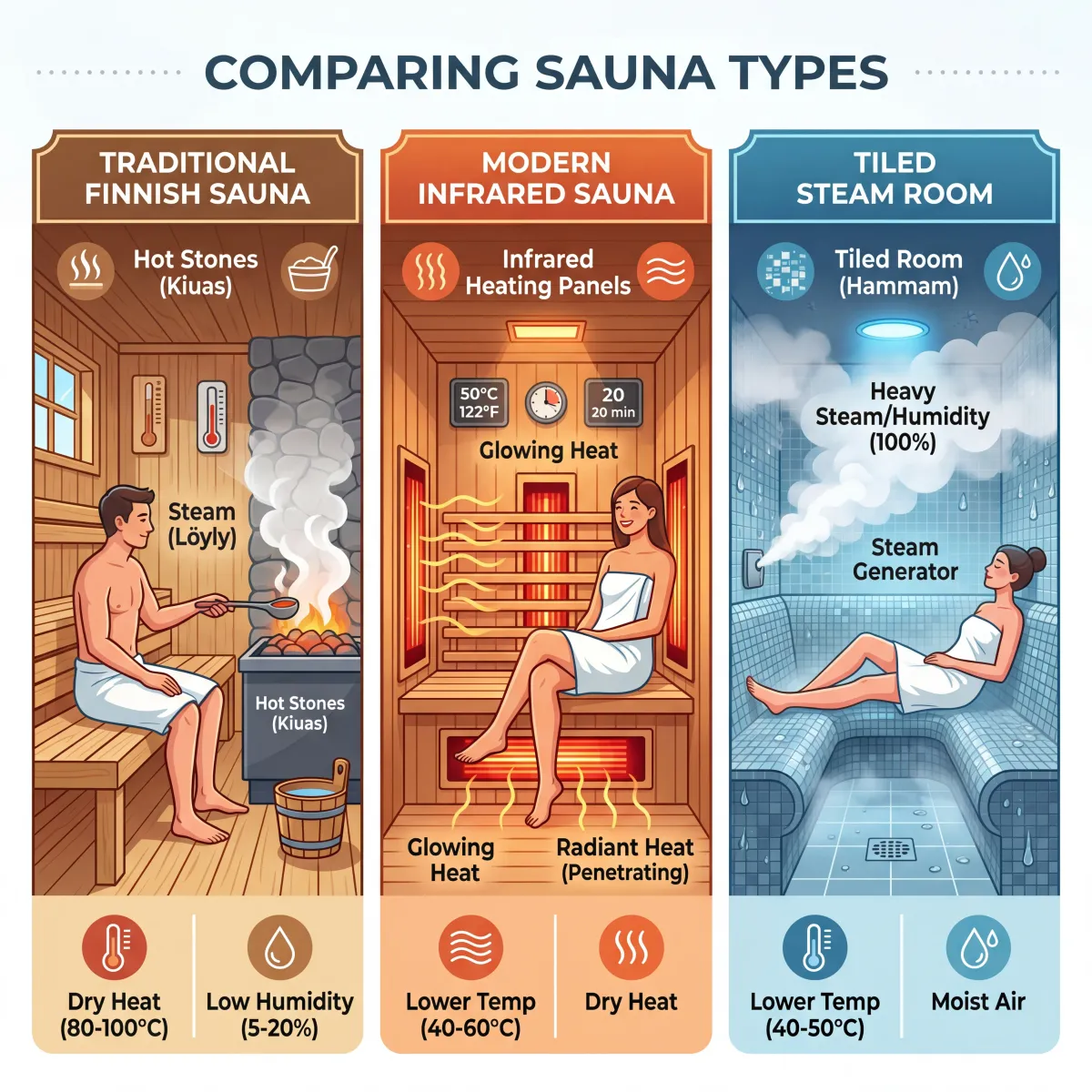
If you are choosing based on research, a traditional dry sauna at 80°C+ has the deepest evidence base by a wide margin. Infrared saunas are gentler and may suit people with heat sensitivity or mobility limitations, but the data supporting their use is limited to specific clinical populations.
How to Use a Dry Sauna Safely
The Finnish approach is straightforward: enter the sauna, sit for 5–20 minutes, cool off, rehydrate, repeat if desired. Most research participants in the major studies used sessions of 15–20 minutes at temperatures around 75–80°C.
Start conservatively. If you have never used a dry sauna, begin with 5-minute sessions and add time gradually. Sit on a lower bench where temperatures are milder.
Hydrate before and after. You will lose significant fluid through sweating. Drink water before entering and continue after you leave. Dehydration is the most common adverse effect — it causes headaches, dizziness, and muscle cramps.
Cool down gradually. The Finnish tradition of alternating hot and cold exposure may provide additional cardiovascular benefits, but do not go directly from a hot sauna into freezing outdoor temperatures without a brief cooldown period.
When to avoid sauna use entirely:
- After consuming alcohol (risk of hypotension, arrhythmias, and dehydration)
- During unstable angina or shortly after a heart attack or stroke
- With severe aortic stenosis or uncontrolled hypertension
- During pregnancy (consult your healthcare provider)
When to consult your doctor first:
- If you have any form of heart disease, heart failure, or take blood pressure medications
- If you have epilepsy or other neurological conditions
- If you are over 65 or under 16
- If you are trying to conceive (male spermatogenesis can be temporarily disrupted by repeated heat exposure, though the systematic review found this effect reversed after stopping sauna use)
For people with stable heart disease and mild heart failure, sauna use appears safe. The systematic review of 40 clinical studies involving 3,855 participants found only one adverse health outcome: the reversible spermatogenesis disruption in a study of 10 men.

Frequently Asked Questions
How often should you use a dry sauna for health benefits?
The strongest health outcomes in research came from using a sauna 4–7 times per week, but benefits appeared starting at 2–3 sessions weekly. Even 2–3 sessions per week was associated with a 22% lower risk of sudden cardiac death in the KIHD study. Start with what is practical for your schedule and increase gradually.
Can dry sauna use help you lose weight?
No. The weight you drop during a sauna session is water loss from sweating, not fat loss. That weight returns immediately with rehydration. There is no clear evidence that sauna use burns meaningful calories or contributes to sustained weight loss.
Is a dry sauna safe if you have high blood pressure?
For most people with controlled hypertension, yes. Research shows sauna use may actually help lower blood pressure over time. However, the acute blood pressure drop during and after a session can interact with antihypertensive medications. Talk to your doctor before starting, and exit the sauna immediately if you feel dizzy or lightheaded.
How long should a dry sauna session last?
Most research used sessions of 15–20 minutes. The KIHD study found greater cardiovascular benefits with sessions over 19 minutes compared to sessions under 11 minutes. Beginners should start with 5 minutes and increase gradually as tolerance builds.
Does a dry sauna detoxify the body?
Sweating does eliminate trace amounts of heavy metals and certain environmental pollutants, but calling sauna use "detoxification" overstates the case. Your kidneys and liver handle the vast majority of waste removal. Sauna sweating is more accurately described as a minor supplementary excretion route, not a primary detox mechanism.
Related Articles
- Inflammation and Chronic Disease: A Complete Guide to Anti-Inflammatory Living — How chronic inflammation drives disease risk and what reduces it.
- Natural Blood Pressure Reduction: Diet, Supplements, and Lifestyle Strategies That Work — Evidence-based approaches to lowering blood pressure without medication.
- Ashwagandha: KSM-66 vs Sensoril, Cortisol, Thyroid, and Full Evidence Review — A cortisol-lowering adaptogen that pairs well with stress-reducing practices.
- Autophagy: How to Trigger It Through Fasting, Exercise, and Diet — Heat stress and sauna use are among the triggers for cellular cleanup processes.
- Magnesium Types Explained: Threonate, Glycinate, Taurate, and Which to Take — Magnesium supports cardiovascular and nervous system health alongside sauna benefits.
Medical Disclaimer
This article is for informational and educational purposes only and is not medical advice, diagnosis, or treatment. Always consult a licensed physician or qualified healthcare professional regarding any medical concerns. Never ignore professional medical advice or delay seeking care because of something you read on this site. If you think you have a medical emergency, call 911 immediately.