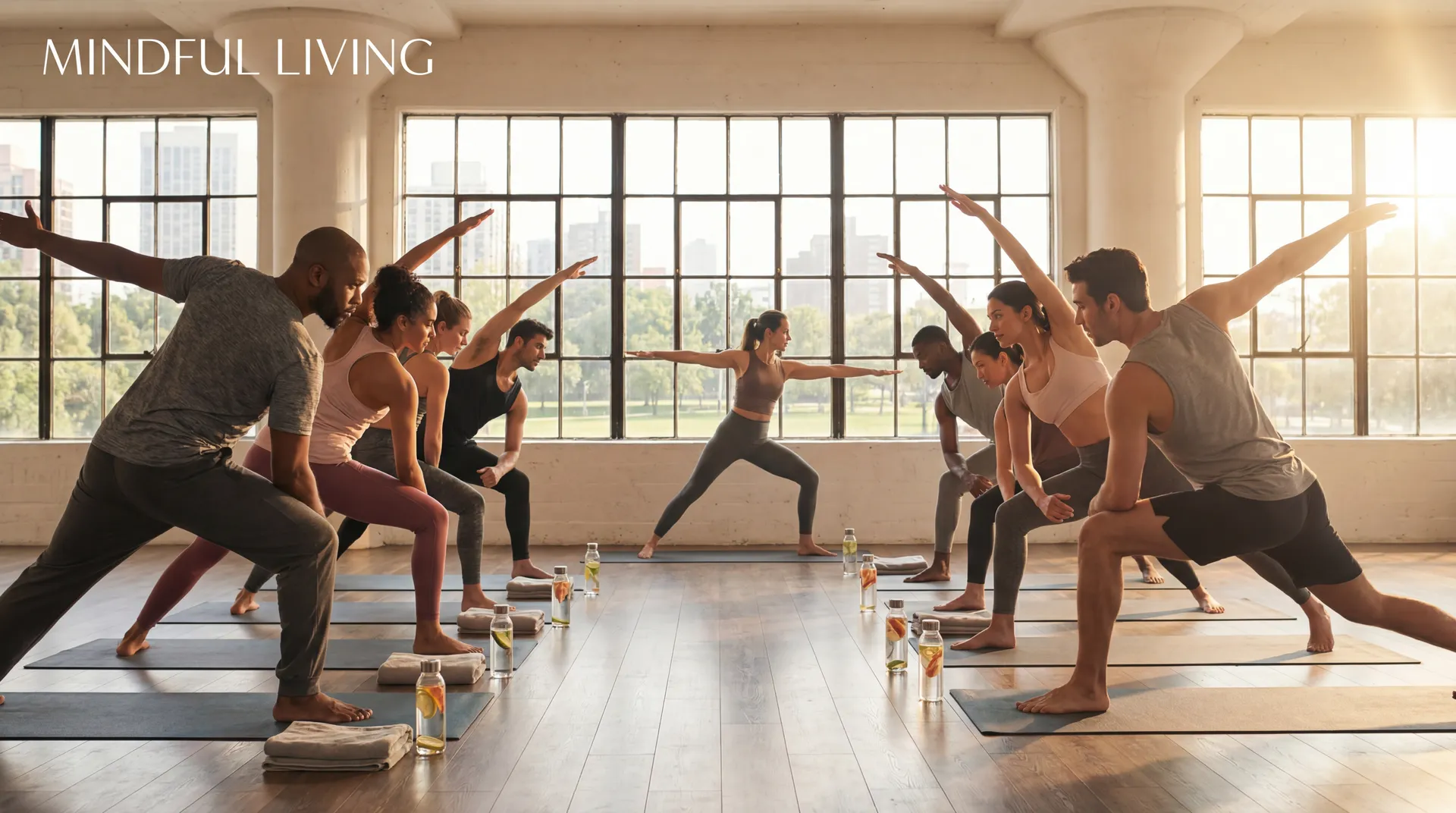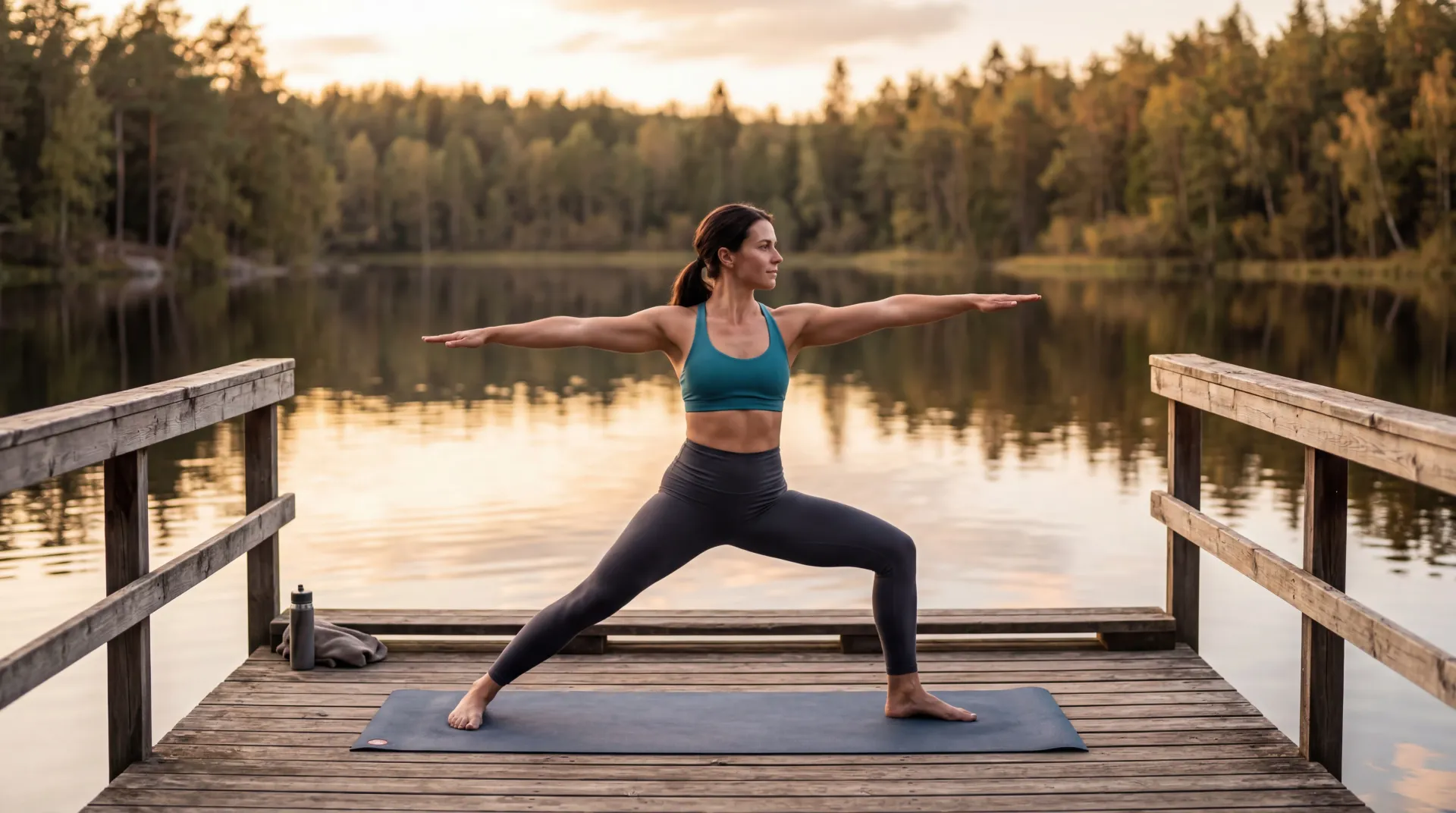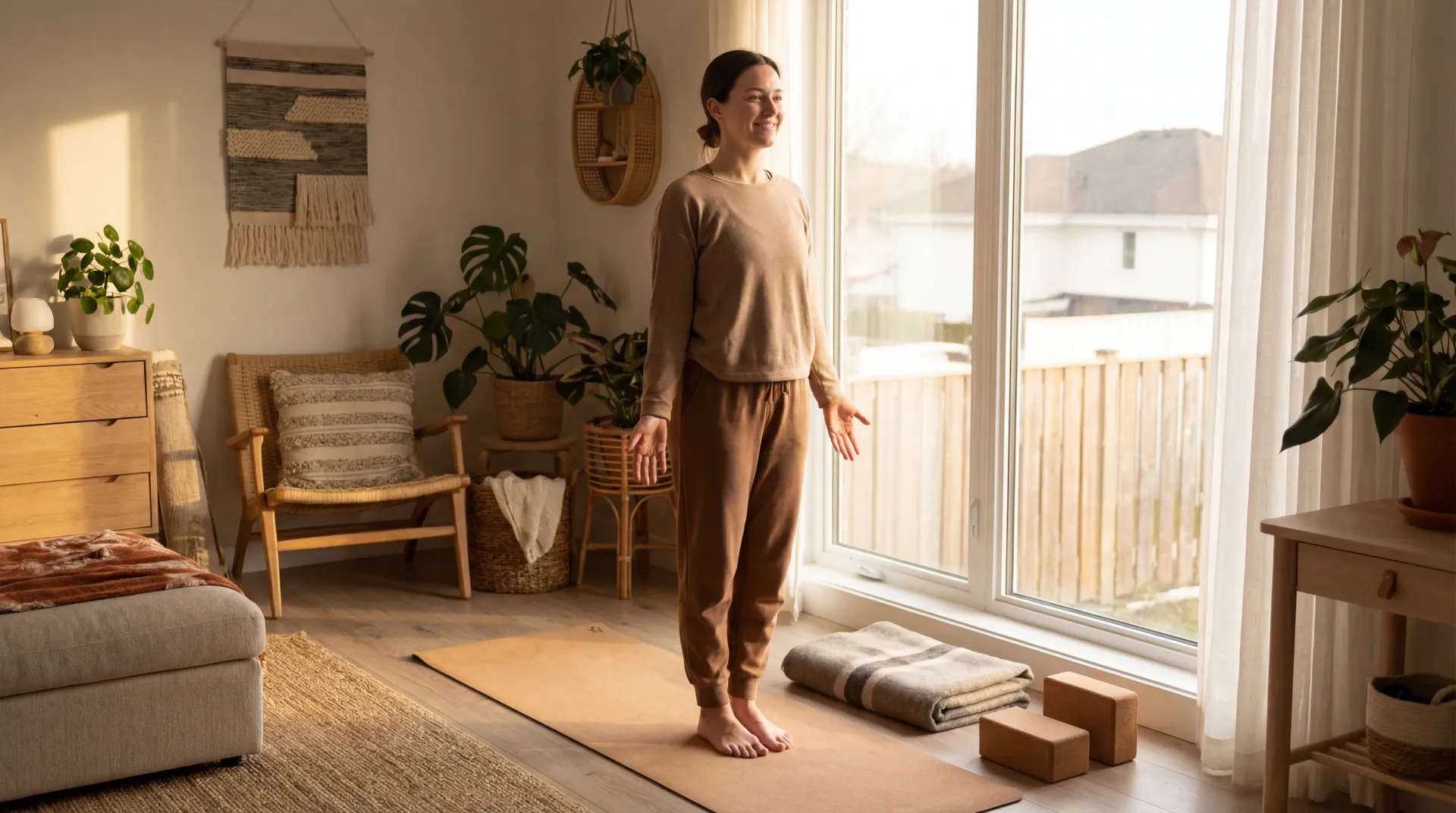
How can beginners make yoga joyful instead of intimidating?
Most beginners do not quit yoga because the poses are "too advanced." They quit because they feel they are doing it wrong. The fastest way to make yoga joyful is to replace performance goals with process goals. Instead of asking, "Can I do the perfect pose?" ask, "Did I breathe steadily, stay present, and finish feeling a little better than when I started?" That mindset creates momentum, and momentum is what turns a short home routine into a long-term habit.
A joyful home practice is usually simple: enough structure to feel guided, enough flexibility to fit real life. If you like checklists, think of each session as three mini blocks: settle, move, recover. Settle means one minute of calm breathing. Move means 10 to 20 minutes of beginner-friendly poses. Recover means two minutes in a restful shape that lets your nervous system downshift. If you already use breathing drills for stress relief, yoga becomes easier because your breath is already acting as your pacing tool.
It also helps to remove friction before you start. Keep your mat visible. Leave one block or folded blanket nearby. Pick two default practice times in your week so you are never negotiating with yourself from scratch. Joy grows when decisions are small. A short practice you can repeat will always outperform a complicated plan you avoid.
Quick reset rule: If your breathing turns choppy, your jaw tightens, or you feel rushed, reduce depth and slow down. In beginner yoga, calm breathing is the signal that the intensity is right.
Many people notice yoga works even better when paired with other low-pressure mind-body habits. On days when your body feels stiff, five minutes of gentle mobility plus seated breathing can still count as a complete practice. On better days, you can extend the session. Consistency, not intensity, is the real training stimulus for beginners.
If your goal is emotional steadiness rather than athletic performance, connect your yoga schedule to your stress patterns. For example, use shorter practices on high-workload days and longer sessions on weekends. This protects your routine from all-or-nothing thinking. For broader mental health context, this companion article on yoga for a healthy mind shows how breath and movement patterns can support mood regulation over time.
What does current research say about yoga for stress, mood, and sleep?
Yoga is not a cure-all, but evidence supports it as a useful part of a broader self-care strategy. The National Center for Complementary and Integrative Health overview on yoga summarizes findings across common concerns, including stress, low back pain, sleep quality, and quality of life. In plain language: many people benefit, especially when practice is regular and realistic.
For stress and anxiety, evidence quality varies by study design, but pooled analyses suggest meaningful symptom improvements for many participants. A systematic review and meta-analysis of randomized trials on yoga for anxiety reported favorable effects in several settings. That does not mean yoga replaces therapy, medication, or clinical treatment when needed. It means yoga can be a practical adjunct that improves day-to-day coping capacity.
Sleep is another frequent reason beginners start. Sleep responds to total lifestyle load, so yoga helps most when paired with sleep hygiene basics. A systematic review and meta-analysis on yoga and sleep quality found improvements across multiple studies, especially when participants practiced consistently over weeks. If better sleep is your main objective, pair evening yoga with wind-down routines like dim light, reduced late caffeine, and steady wake times. You can reinforce this with practical habits from these simple sleep improvement tips.
For physical function, yoga can reduce pain sensitivity and improve confidence in movement, especially for people who are deconditioned or recovering from sedentary periods. A Cochrane review on yoga for chronic non-specific low back pain found that yoga may offer small to moderate benefits for function and pain, with safety depending on appropriate progression and modifications.
Context matters too. Global activity guidelines are clear that movement improves long-term health outcomes, and yoga can be one of the easiest on-ramps for beginners who dislike traditional workouts. The World Health Organization physical activity guidance and the CDC physical activity basics both reinforce that regular movement matters more than perfect programming.
| Outcome area | What research generally shows | What this means for beginners | Best practice |
|---|---|---|---|
| Stress and anxiety | Yoga often improves symptoms when practiced regularly | Useful supportive tool, not a stand-alone cure | Combine breath-paced movement with professional care when needed |
| Sleep quality | Many studies show modest improvements over time | Best results with routine and good sleep habits | Use short evening sequences and stable sleep timing |
| Low back discomfort | Can improve function and pain in selected groups | Progressive loading and form cues matter | Start with gentle range and avoid forcing end range |
| General wellbeing | Improved body awareness and self-efficacy are common | Helps adherence for people who dislike high-intensity exercise | Keep sessions short enough to repeat 3 to 5 times weekly |
Which 5 beginner poses build a strong home foundation?
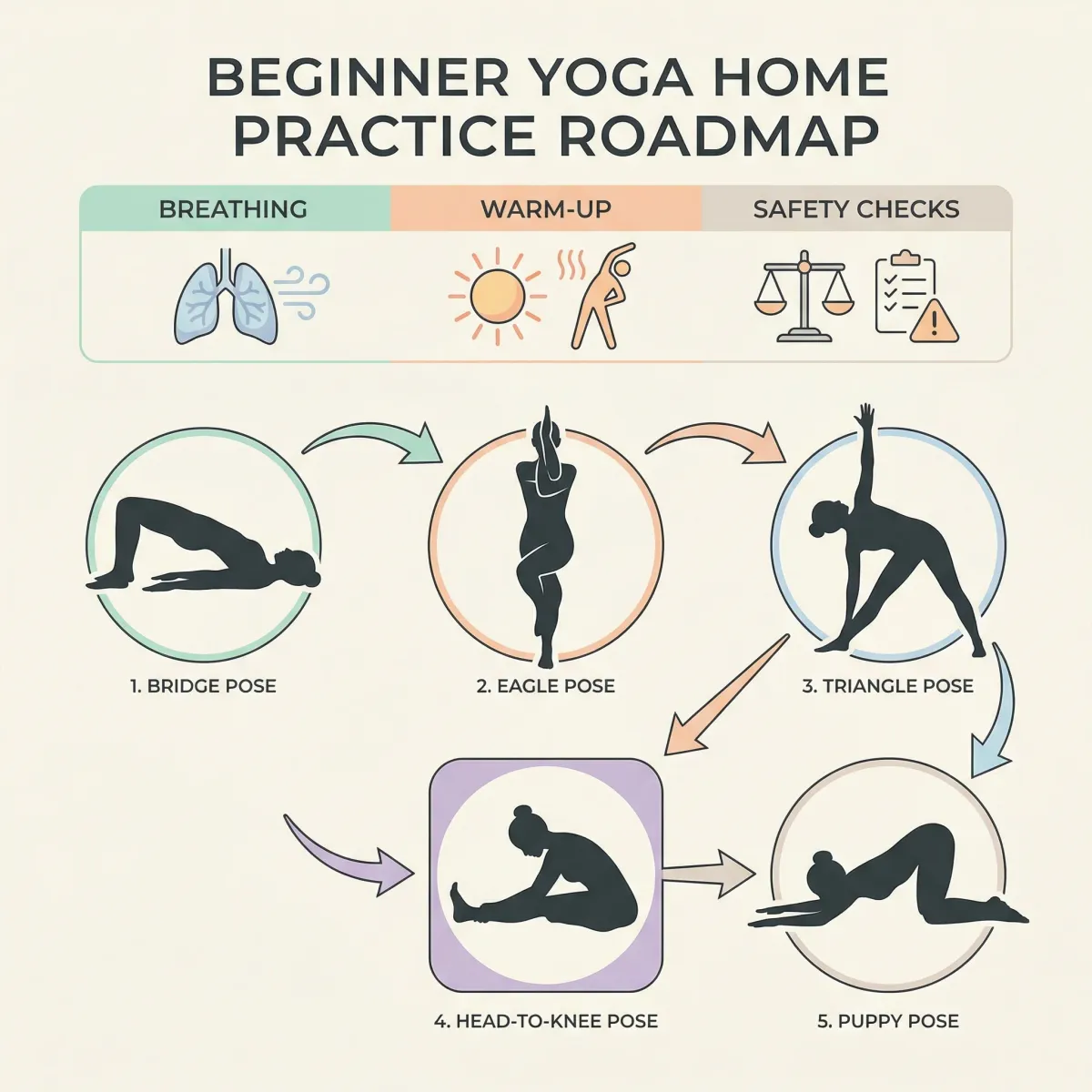
The original version of this article listed five beginner-friendly poses, and that foundation still works. Bridge, Eagle, Extended Triangle, Head-to-Knee Forward Bend, and Puppy Pose create a balanced beginner toolkit across strength, balance, mobility, and down-regulation. The key is not how deep each shape looks; the key is whether you can breathe, stabilize, and leave the pose with control.
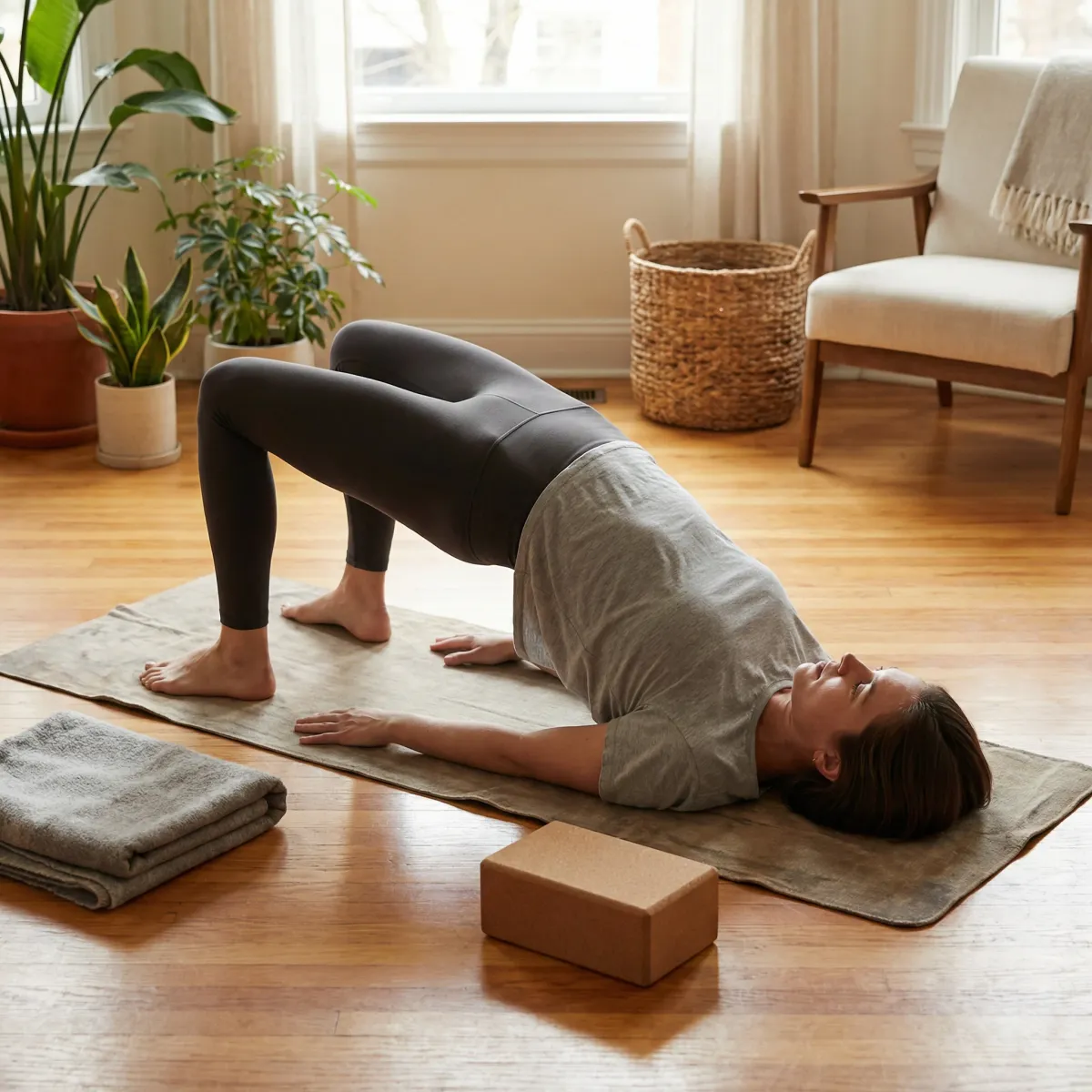
Bridge Pose
Bridge is a beginner staple because it trains posterior-chain strength, spinal articulation, and breath coordination without requiring high balance demands. Press your feet into the floor, lift the pelvis gradually, and keep the neck neutral. Think "long through knees" instead of "high as possible." If hamstrings cramp, shorten the hold and move your feet slightly farther from your hips.
Eagle Pose
Eagle builds balance, hip control, and upper-back engagement. Beginners can keep the lifted toes on the floor as a kickstand instead of wrapping fully. Focus your eyes on one still point and exhale into the squeeze pattern. It is normal to wobble. Wobbling is not failure; it is balance training in progress.
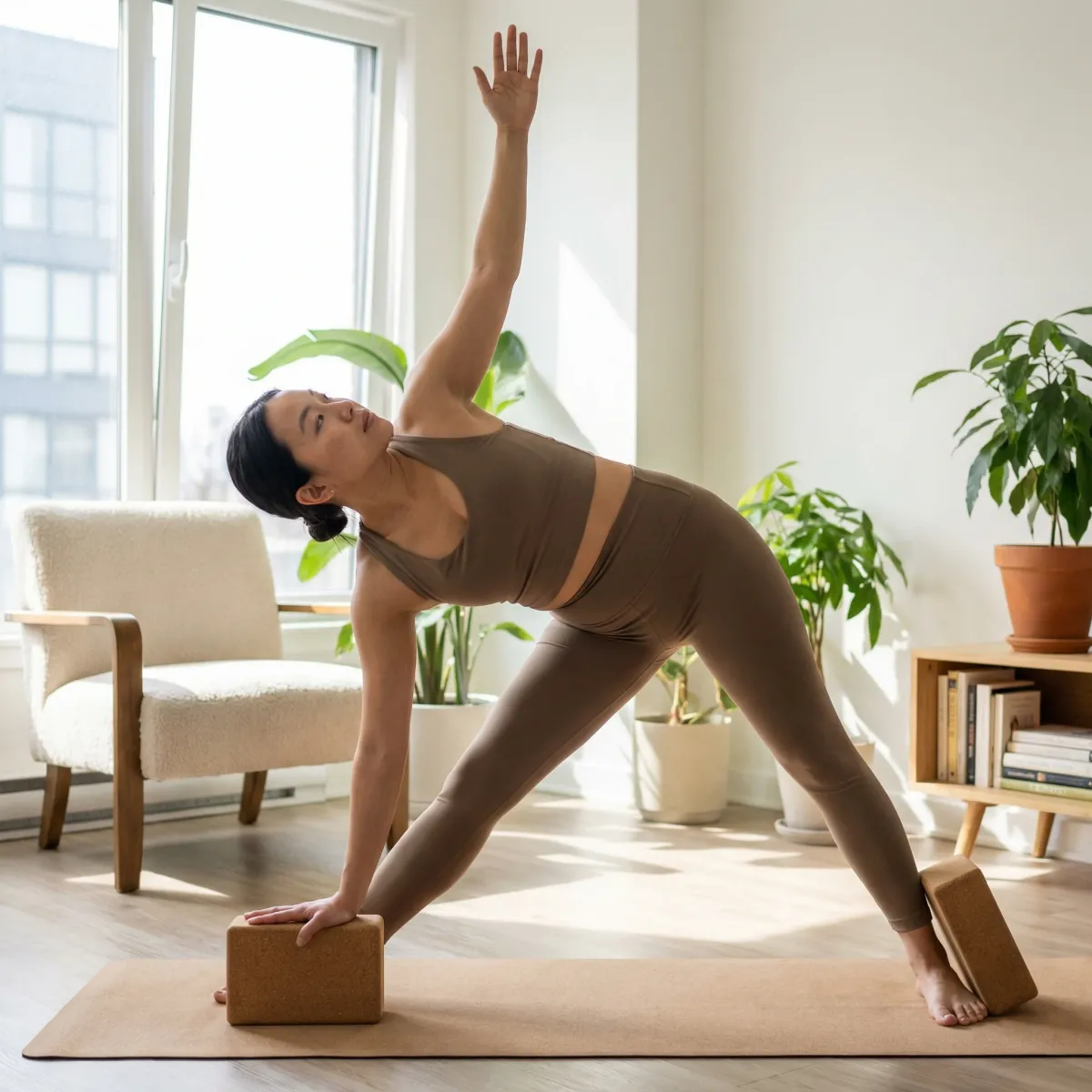
Extended Triangle Pose
Triangle improves lateral hip mobility, thoracic rotation, and postural awareness. Use a block under the lower hand so the chest can stay open and the spine long. If you feel pinching in the lower back, shorten your stance and soften both knees. Triangle should feel spacious, not compressed.
Head-to-Knee Forward Bend
This seated fold supports hamstring mobility and nervous-system settling. Keep your spine long as you hinge forward, and prioritize length over depth. A strap around the extended foot can prevent rounding and shoulder strain. In early weeks, 4 to 6 calm breaths per side is enough.
Puppy Pose
Puppy Pose bridges active and restorative work. It opens shoulders and chest while encouraging diaphragmatic breathing. Keep hips stacked above knees and avoid collapsing into the lower back. Place a folded blanket under the chest or forehead if your shoulders feel restricted.
| Pose | Primary beginner benefit | Common mistake | Simple modification |
|---|---|---|---|
| Bridge | Glute and posterior-chain activation | Overarching lower back | Lower height and engage ribs down |
| Eagle | Single-leg balance and focus | Forcing full leg wrap too soon | Use toe kickstand |
| Extended Triangle | Lateral mobility and posture | Collapsing chest toward floor | Use block under lower hand |
| Head-to-Knee Fold | Hamstring mobility and calm | Rounding and yanking forward | Use strap and bend knee slightly |
| Puppy | Shoulder opening and down-regulation | Sinking into lumbar extension | Support chest with blanket |
If your broader goal includes body-composition support, yoga can still play a role, especially when used for consistency and stress management. This guide on how to lose weight with yoga explains how to combine yoga sessions with realistic nutrition and activity planning.
How long should a starter routine be to stay consistent?
The best routine length for beginners is usually 15 to 25 minutes, performed most days you reasonably can. That window is long enough to improve mobility and calm the nervous system, but short enough to survive busy schedules. A common mistake is chasing long sessions too early, then skipping the next three days from soreness or time pressure.
Use this simple structure:
- 2 minutes: seated or lying breath regulation.
- 10 to 15 minutes: your five foundational poses with short holds.
- 3 to 5 minutes: gentle cooldown, then quiet breathing.
When life is chaotic, convert to a 10-minute minimum routine instead of cancelling entirely. Habit continuity matters more than single-session duration. If you also practice meditation, stack yoga directly before it. This article on meditation techniques and benefits can help you build that sequence.
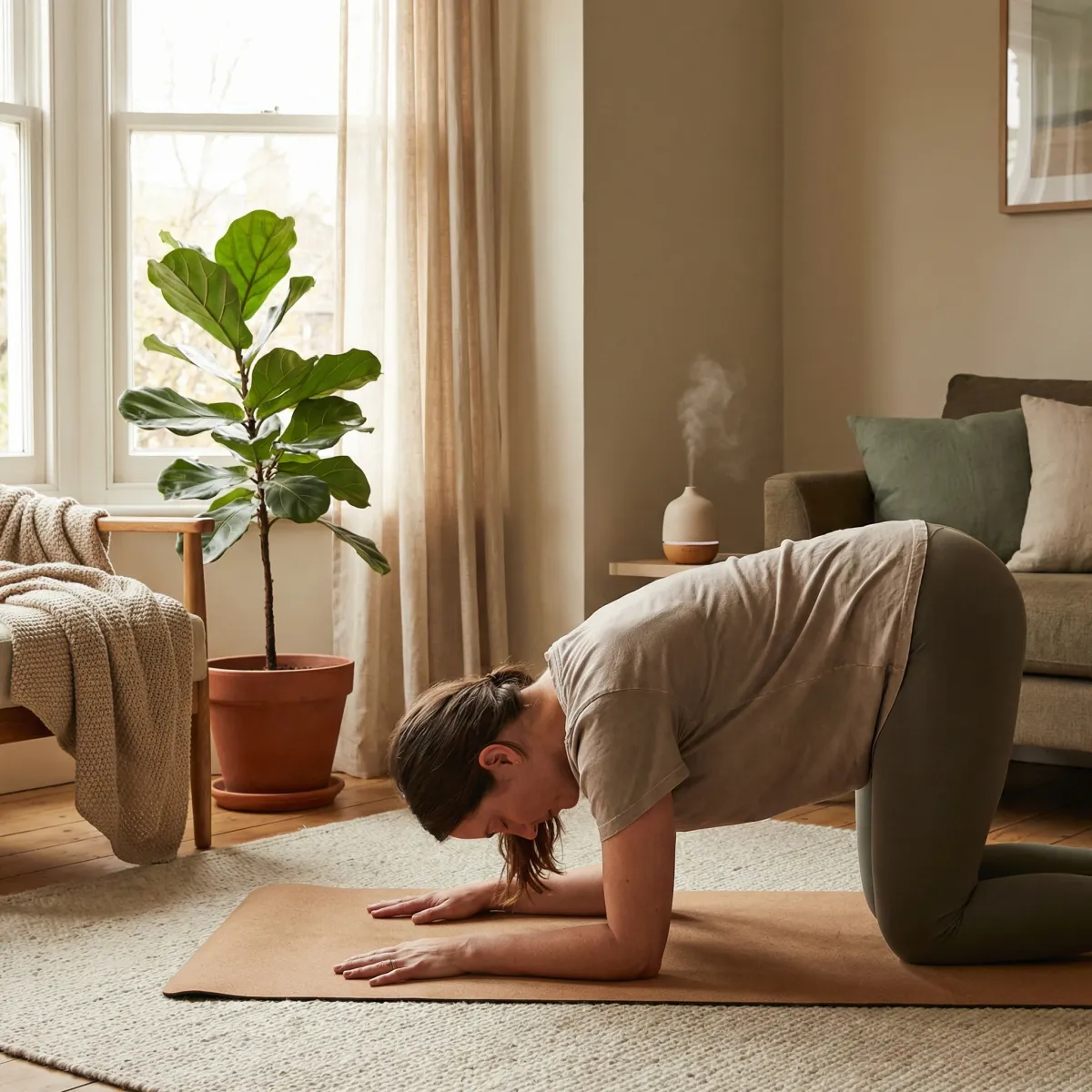
Sleep-sensitive beginners may prefer evening sessions that emphasize forward folds, supported shapes, and extended exhales. The CDC sleep health overview and NHLBI sleep resources both reinforce that recovery quality affects mood, energy, and decision-making. Yoga can be a practical pre-sleep bridge from "alert" to "ready to rest," especially if screens and bright light are reduced during the same window.
| Schedule type | Total weekly yoga time | Who it fits best | Expected adherence |
|---|---|---|---|
| 5 x 15 minutes | 75 minutes | Busy beginners with variable days | High, because sessions are easy to start |
| 3 x 25 minutes | 75 minutes | People who prefer longer focused blocks | Moderate, depends on calendar control |
| 2 x 35 minutes + 2 x 10 minutes | 90 minutes | Mixed schedules needing flexibility | High when short sessions are treated as valid |
Myth vs fact: common beginner yoga misconceptions
Beginner yoga gets derailed by myths more than mechanics. The most persistent myth is that yoga "only counts" if a pose looks advanced. In reality, progress comes from breath quality, stable alignment, and regular exposure. Another myth is that pain equals progress. Yoga can challenge you, but sharp or escalating pain is a stop signal, not a badge of effort.
| Myth | Fact | Better beginner approach |
|---|---|---|
| "If I am not flexible, yoga is not for me." | Flexibility is often an outcome of practice, not a prerequisite. | Use props, smaller ranges, and steady breathing. |
| "Long sessions are always better." | Consistency and recovery beat occasional marathon sessions. | Prioritize repeatable 15 to 25 minute sessions. |
| "Balance problems mean I am bad at yoga." | Wobbling is normal and part of motor learning. | Use wall support and fixed gaze points. |
| "Yoga replaces every other form of exercise." | Yoga is valuable, but many people benefit from mixed movement patterns. | Combine yoga with walking or resistance work when possible. |
| "I should push through pain to improve faster." | Persistent pain increases injury risk and lowers adherence. | Back off intensity and seek form support early. |
For stress-heavy weeks, yoga plus basic breathing drills can outperform trying to "train harder" through exhaustion. The American Psychological Association guidance on stress and the body explains why chronic stress can alter sleep, attention, and tension patterns, all of which influence how movement feels. Your yoga practice should lower total strain, not add to it.
What safety checks matter most before your first week?
Safe beginner yoga is mostly about sensible boundaries. Start with a quick pre-session check: energy level, pain level, and available time. If energy is low, reduce intensity. If pain is high, choose mobility and breathwork only. If time is short, run a micro-session and move on. This keeps your routine protective instead of punitive.
Use the following checklist before each session:
- Can you breathe through your nose comfortably at rest? If not, slow down and simplify.
- Do you have sharp joint pain today? Avoid deep end ranges and loaded balance poses.
- Do you have enough space to move safely around your mat? Remove clutter first.
- Are you hydrated and at least somewhat fueled? Extremely fasted and dehydrated sessions feel harder than necessary.
- Can you stop two reps before form breaks down? If no, shorten the hold immediately.
If you are pregnant, have uncontrolled blood pressure, recent surgery, or a known medical condition, ask a qualified clinician what modifications are appropriate. General public guidance such as the NHS beginner yoga overview and evidence summaries like the NCBI Bookshelf review on yoga and health outcomes can help with baseline orientation, but individualized medical advice should come from your own care team.
One more safety point: stop comparing your body to demonstration videos. Many demonstrations use experienced practitioners with years of mobility exposure. Your job is to train your own current capacity. A beginner session is successful if it leaves you feeling steadier, clearer, and physically safer than before you started.
How to build a practical 4-week progression at home
A four-week block is long enough to feel progress and short enough to adjust quickly. Keep the pose list stable and increase only one variable at a time: hold length, total rounds, or balance complexity. This reduces decision fatigue and improves confidence.
| Week | Session target | Progression focus | Stop rule |
|---|---|---|---|
| Week 1 | 4 sessions, 15 minutes each | Learn shape and breathing rhythm | Stop any hold that disrupts smooth breathing |
| Week 2 | 4 sessions, 18 to 20 minutes | Add 1 to 2 breaths per hold | Do not increase depth and duration together |
| Week 3 | 4 to 5 sessions, 20 minutes | Improve transitions and balance control | Use support if balance quality drops |
| Week 4 | 5 sessions, 20 to 25 minutes | Choose one pose to deepen safely | Keep one full recovery day each week |
If fat loss or metabolic health is part of your broader plan, this progression can pair well with light walking and simple strength work. Yoga supports consistency and recovery, while other modalities can add additional cardiorespiratory or strength stimulus. A realistic approach is to combine enjoyable yoga sessions with sustainable nutrition and weekly movement targets instead of forcing extreme short-term routines.
At the end of each week, ask three reflection questions: Did I practice at least three times? Did my breathing feel easier by the end of sessions? Do I feel more confident entering and exiting the five core poses? Those are meaningful beginner metrics. You do not need advanced shapes to prove progress.
Finally, keep joy visible in your plan. Choose one element you genuinely enjoy, such as music-free quiet, a specific mat location, or a two-minute cooldown ritual. Enjoyment is not optional fluff; it is an adherence multiplier. A practice that feels supportive is the one you return to.
Frequently Asked Questions
How often should a beginner do yoga at home?
Most beginners do best with 3 to 5 short sessions per week. Frequency builds motor learning and confidence faster than occasional long classes.
Do I need expensive equipment to start?
No. A mat, a folded blanket, and optional blocks are enough for most home beginners. Household substitutes can work while you test what you actually use.
What if I cannot do one of the five poses yet?
Use a modification and stay with calm breathing. Progressively scaled versions are still valid training and often produce better long-term results than forced full expressions.
Is yoga enough for stress and sleep problems?
Yoga can help substantially, but best outcomes usually come from combining yoga with sleep hygiene, stress management, and professional care when symptoms are persistent or severe.
How quickly should I expect results?
Many people feel better after the first few sessions, but durable changes in mobility, stress response, and sleep quality usually appear over consistent practice across several weeks.
Related Articles
- Top 10 Breathing Techniques to Relieve Stress - Use these drills before or after yoga to improve calm and recovery.
- Yoga for a Healthy Mind - Learn how consistent yoga can support focus, mood, and emotional balance.
- 10 Simple Tips to Improve Your Sleep - Pair evening yoga with practical sleep habits for better overnight recovery.
- Meditation Techniques, Guides, Tips and Benefits - Build a simple yoga-plus-meditation routine for mental clarity.
- How to Lose Weight With Yoga - Combine yoga with sustainable nutrition and movement patterns for long-term results.
Medical Disclaimer
This article is for informational and educational purposes only and is not medical advice, diagnosis, or treatment. Always consult a licensed physician or qualified healthcare professional regarding any medical concerns. Never ignore professional medical advice or delay seeking care because of something you read on this site. If you think you have a medical emergency, call 911 immediately.